
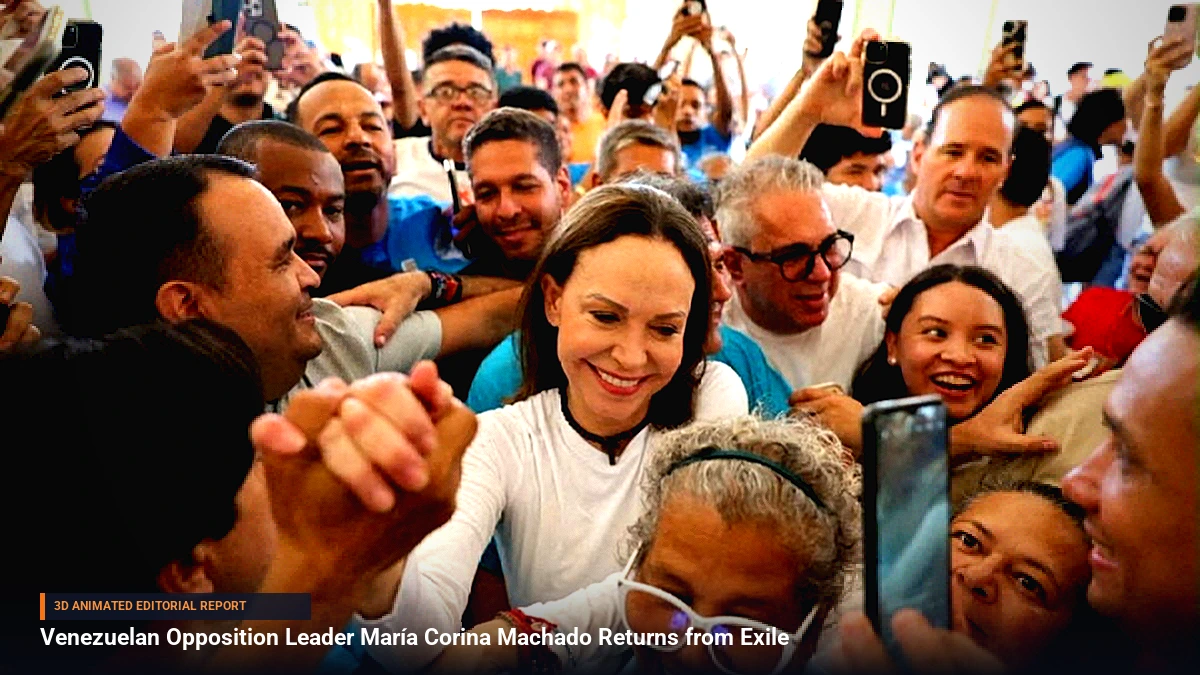
What Happened: The Core Developments
Venezuelan opposition leader María Corina Machado has officially returned to her home country after spending nearly a year in exile. Her dramatic reentry marks a significant escalation in the ongoing political struggle within the South American nation. Machado's homecoming comes directly on the heels of widespread national demonstrations, where citizens flooded the streets to demand transparent governance and legitimate, free elections. Declaring her presence directly to the public with the defiant message, "I am here. With you," the Nobel laureate's arrival immediately alters the domestic political landscape, injecting renewed energy into a fractured anti-government movement that has faced intense state pressure.
Background & Key Context
For months, Venezuela has experienced heightened political volatility, compounded by deepening economic crises and severe restrictions on civic freedoms. Machado, a prominent figure in the resistance against the ruling administration, was forced into exile nearly a year ago amid intensifying state crackdowns on political dissidents and opposition organizers. Despite her physical absence from the country, she maintained a powerful symbolic and strategic leadership role. The protests that precipitated her return underscore deep-seated public exhaustion with authoritarian rule, as citizens continue to demand accountability and the restoration of constitutional norms following disputed electoral cycles that drew international condemnation.
Key Takeaways
- Return from Exile: María Corina Machado has re-entered Venezuela after nearly a year operating from outside the country.
- Catalyst for Return: Her homecoming follows sustained national protests calling for democratic transitions and free elections.
- Symbolic Leadership: As a Nobel laureate, Machado commands immense international prestige and domestic loyalty, elevating the visibility of the opposition.
- Heightened Tensions: Her presence back on domestic soil significantly raises the stakes for both the ruling government and civil society.
Impact, Analysis & Global/National Reactions
Machado's return is widely viewed by political analysts as a calculated, high-risk maneuver designed to galvanize a demoralized populace and pressure the ruling regime into genuine concessions. International observers note that her re-entry strips away the physical barrier of exile, allowing her to coordinate resistance efforts more directly on the ground. However, human rights organizations and foreign diplomats have expressed profound concern for her safety, warning that state authorities might resort to immediate detention or further legal harassment. Stakeholders across the international community are closely monitoring the regime's reaction, as any aggressive crackdown on Machado could trigger fresh rounds of domestic unrest and provoke harsher global economic sanctions.
What's Next: Looking Ahead
As Machado re-establishes her physical presence inside Venezuela, all eyes turn toward how the government will respond to her localized mobilization efforts. Upcoming political gatherings, potential state legal maneuvers, and the international community's diplomatic posture will dictate the trajectory of the country's democratic movement. Observers will be tracking whether her return can successfully bridge fragmented opposition factions into a unified front capable of forcing meaningful electoral reform in the near future.

Be the first to comment
Start a useful conversation around this story.