
What Happened: The Core Developments
The Hashemite Kingdom of Jordan launched a series of aggressive retaliatory airstrikes targeting armed militant positions within neighboring Syria. The military action comes directly on the heels of a horrific domestic assault: a Greek Orthodox church in the southern Jordanian governorate of Karak was targeted in an atrocity that claimed the lives of nine people and wounded dozens of others.
According to official statements released by the Jordanian air force, the cross-border operation successfully struck terrorist hideouts and vehicles, resulting in the elimination and wounding of numerous extremists. Jordanian authorities later specified that the bombardments neutralized more than 20 Islamic State militants.
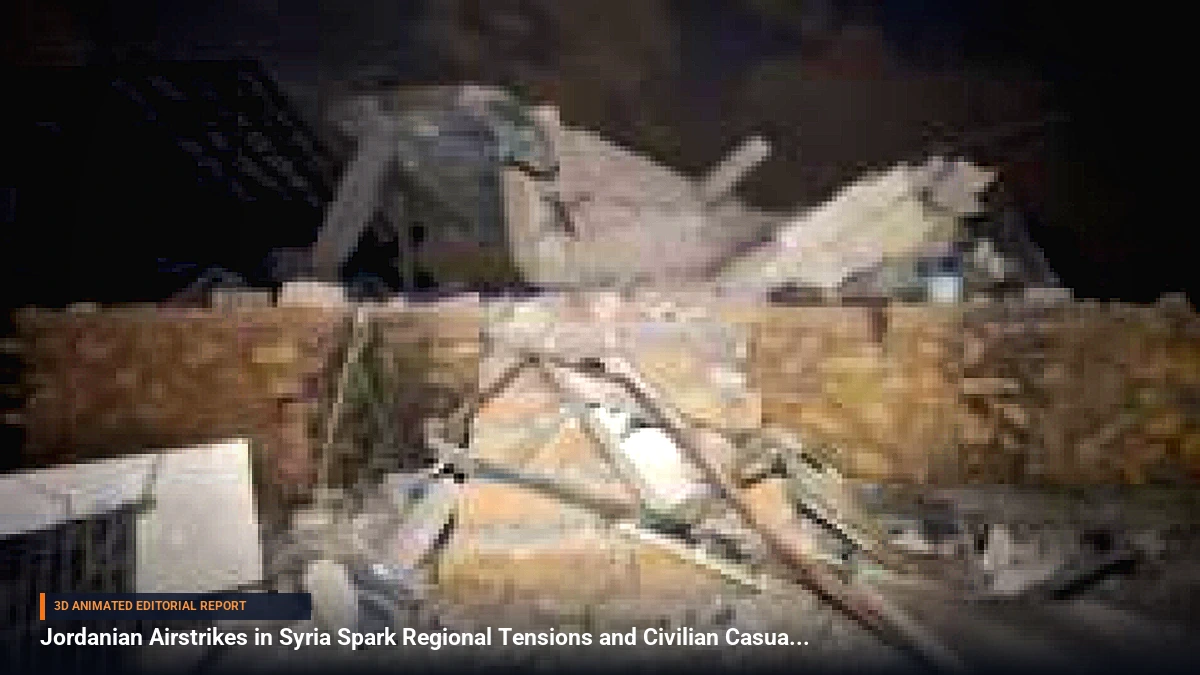
However, a stark divergence has emerged regarding the operational fallout on the ground. Syrian health officials, alongside international news gatherers, reported that the strikes hit populated residential areas, killing several individuals—including women and children. Furthermore, local families of the deceased victims have come forward to vehemently deny any ties or affiliations with the network responsible for the Karak church attack.
Background & Key Context
Cross-border security friction between Amman and Damascus has historically centered on drug smuggling, militant spillover, and the ongoing instability within southern Syria. Jordan has maintained a vigilant defensive posture along its northern frontier, frequently employing precision strikes or border enforcement operations to preempt infiltration by extremist factions.
The trigger for this recent escalation—the assault on the Karak church—shocked the peaceful co-existence historically championed within the region. Security forces moved swiftly within Jordan, arresting multiple primary suspects in connection with the church massacre. Yet, the pursuit of justice quickly spilled past international borders, leading to the unauthorized or contested aerial incursions into Syrian airspace.
Key Takeaways
- Retaliatory Action: Jordan's air force struck targets in Syria in direct response to a church massacre in Karak that left nine dead.
- Disputed Death Tolls: Amman reports eliminating over 20 Islamic State militants, while Syrian officials and local reports confirm civilian fatalities, including women and children.
- Local Denials: Families of those killed in the Syrian bombardments have strongly rejected any connection to the church attack.
- Damascus Condemnation: The Syrian government has formally condemned the Jordanian military operations as a blatant and unacceptable violation of its national sovereignty.
- Domestic Security Measures: Alongside foreign strikes, Jordanian authorities have apprehended several suspects domestically in connection with the initial church tragedy.
Impact, Analysis & Global/National Reactions
The operation underscores the precarious security balance facing Middle Eastern nations that must contend with transnational jihadist cells operating in fragmented territories like southern Syria. For Jordan, demonstrating a decisive and unyielding response to attacks on its civilian and religious institutions is a domestic political imperative.
Conversely, the Syrian government swiftly denounced the unilateral airstrikes, labeling them an unacceptable violation of sovereignty. The emergence of civilian casualties complicates Amman’s narrative, turning what was intended as a targeted counter-terrorism victory into a humanitarian and diplomatic flashpoint. Human rights observers note that the lack of independent verification regarding the exact identities of those killed in Syria leaves room for dangerous escalations and neighborhood-level radicalization.
What's Next: Looking Ahead
As diplomatic channels strain under the weight of the unauthorized strikes, regional observers will be closely monitoring whether Damascus seeks formal recourse through international bodies or if back-channel military de-escalation can be achieved. Domestically, Jordan faces judicial proceedings concerning the detained suspects of the Karak church attack, trials that will be intensely scrutinized by the public. Meanwhile, intelligence agencies on both sides of the border remain on high alert for further retaliatory cycles or militant exploitation of the diplomatic rift.






Be the first to comment
Start a useful conversation around this story.