
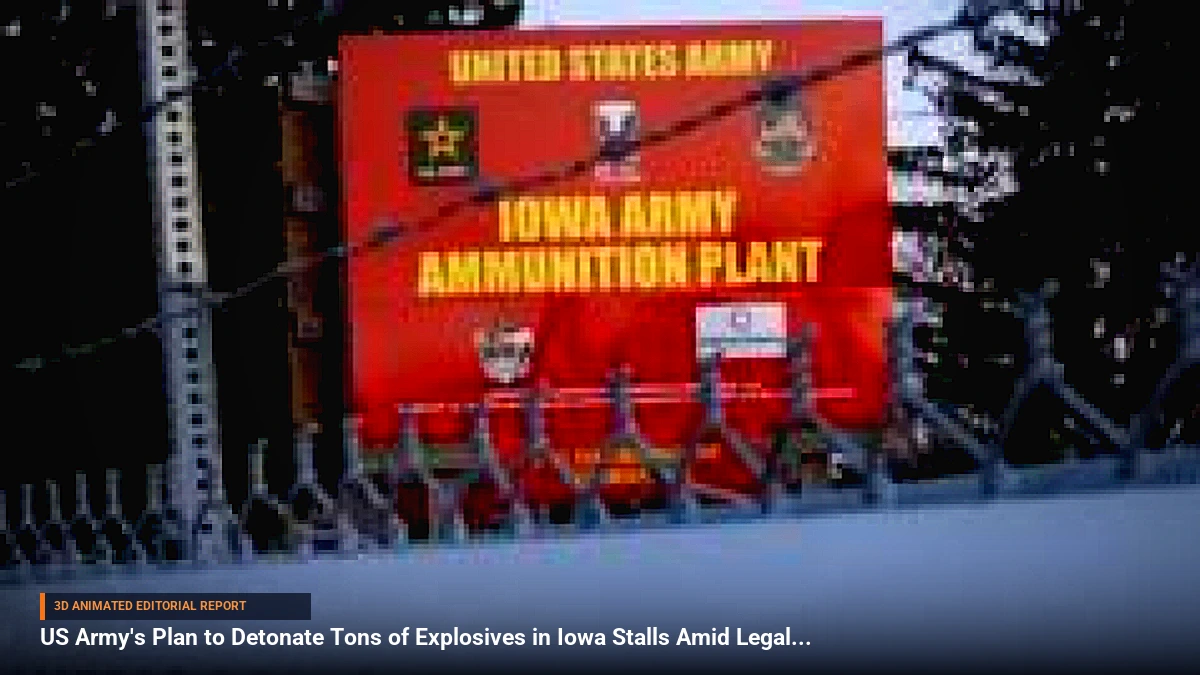
What Happened: The Core Developments
The US Army found itself at the center of a fierce legal and environmental standoff after announcing plans to destroy roughly 4 to 5 tons of degraded, highly unstable bomb-making chemicals. Stored inside barrels at an ammunition plant located in Middletown, Iowa—where nearly 400 residents live, with thousands more in surrounding communities—the material consisted primarily of lead azide, a notoriously sensitive and volatile explosive compound.
The military's initial strategy involved executing a controlled detonation to eliminate the material quickly. However, environmental advocacy groups swiftly intervened, filing a federal lawsuit that secured a court-ordered stay to halt the operation. The plaintiffs cited profound public health, safety, and pollution risks associated with scattering lead-based particulate matter into the local atmosphere and soil. Despite the judicial roadblock, the Army initially attempted to invoke emergency powers, arguing that swift action was paramount to avert a catastrophic accidental explosion that could endanger military personnel and nearby civilians alike.
Background & Key Context
The dilemma highlights a recurring challenge for defense logistics: the safe disposal of aging, degraded munitions and chemical precursors that become increasingly dangerous over time. Lead azide serves as a primary detonating agent in various military applications, but as it degrades, it grows exponentially more unpredictable and hazardous to handle or transport.
Middletown, Iowa, has long hosted military ordnance manufacturing and storage infrastructure. Yet, the proximity of massive quantities of unstable energetics to civilian populations has consistently raised alarms among local residents and environmental watchdogs. The latest confrontation underscores the friction that occurs when federal military necessity collides with state-level environmental protection statutes and civilian judicial oversight.
Key Takeaways
- Massive Volume: The US Army planned to detonate approximately 4 to 5 tons of degraded lead azide stored in 68 barrels.
- Local Population at Risk: The ammunition plant is situated in Middletown, Iowa, home to roughly 400 residents, with thousands more living in adjacent zones vulnerable to airborne fallout.
- Judicial Intervention: Environmental groups successfully secured a court-ordered stay to freeze the detonation over severe pollution and health apprehensions.
- Emergency Powers Invoked: The military initially pushed to bypass the injunction, claiming emergency executive authority was required to protect personnel from an accidental disaster.
- Political Deference: Leadership, including Donald Trump, indicated that the administration would defer to the federal appeals court to resolve the impasse.
Impact, Analysis & Global/National Reactions
The controversy has catalyzed a broader debate regarding executive and military overreach versus environmental justice. Legal scholars and civil society groups have expressed deep concern over the precedent of invoking military emergency exemptions to circumvent federal court orders.
"This situation is extremely concerning," noted environmental advocates involved in the litigation, pointing out that detonating tons of toxic heavy metals risks contaminating local water tables and food chains. Conversely, defense analysts point out the severe logistical nightmare of safely moving degraded lead azide over public highways, arguing that on-site destruction, while messy, is sometimes viewed by engineers as the least worst option.
Politically, the stakes intensified when Donald Trump stated that he would defer entirely to the federal appeals court's upcoming determinations, effectively placing the immediate fate of the operation into the hands of the judiciary rather than purely executive fiat.
What's Next: Looking Ahead
All eyes are now turned toward the federal appeals court, which must untangle the complex web of military necessity, statutory environmental protections, and constitutional separation of powers.
If the court upholds the injunction, the US Army will be forced to develop alternative, non-detonation disposal technologies or secure safer transportation protocols to move the volatile barrels to a specialized hazardous waste facility. Regardless of the outcome, the Middletown incident serves as a critical blueprint case for how federal agencies and local communities will negotiate the hazardous cleanup of Cold War-era and modern military stockpiles in the future.






Be the first to comment
Start a useful conversation around this story.