
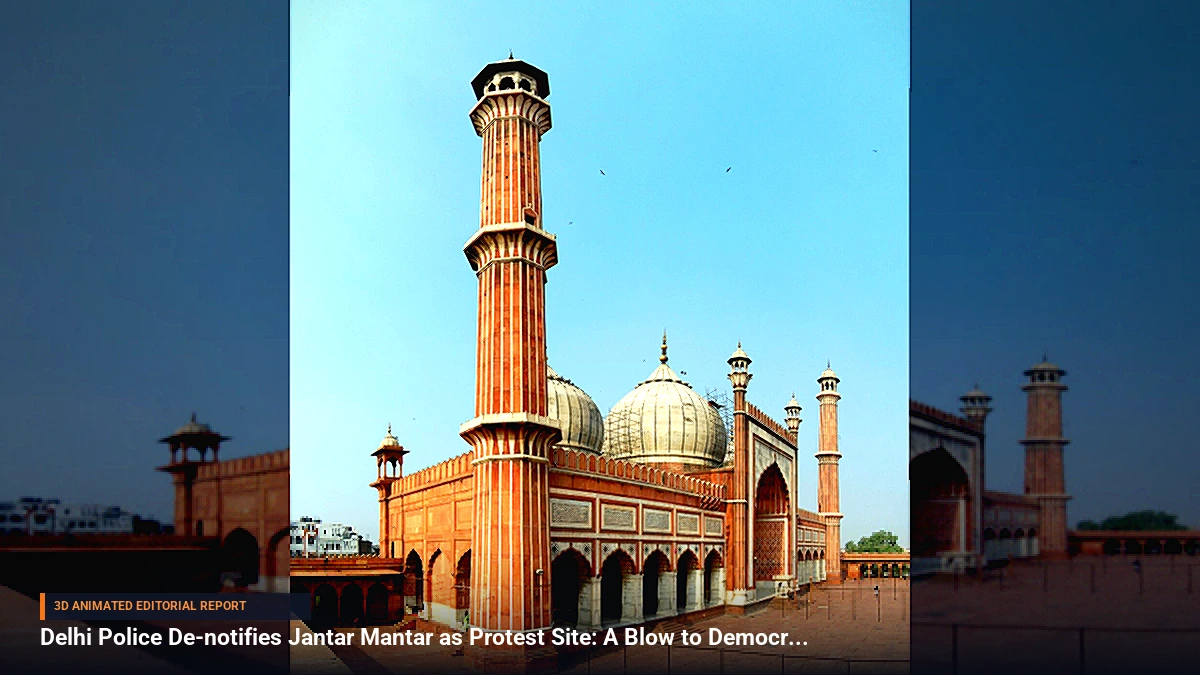
What Happened: The Core Developments
The landscape of public demonstration in New Delhi has experienced a profound structural shift following a joint decision by the Delhi Police and the Ministry of Home Affairs to officially de-notify Jantar Mantar as a designated protest site. For decades, this iconic avenue situated in the heart of the national capital served as the primary physical manifestation of civic opposition, accommodating labor unions, students, anti-corruption crusaders, and aggrieved citizens. By revoking its official status, authorities have effectively outlawed spontaneous and organized demonstrations in a space historically recognized for its accessibility.
The immediate consequence of this de-notification is a tightening of regulatory control over where and how citizens can voice grievances against state and central policies. While authorities have pointed toward urban planning, traffic management, and security protocols to justify the administrative adjustment, civil society organizations view the move as a systematic attempt to push dissent to the physical margins of the city, away from the seats of political power.
Background & Key Context
Jantar Mantar's journey as the epicenter of Indian civic activism spans decades. Named after the 18th-century astronomical observatory located nearby, the stretch became the default venue for public assembly due to its proximity to Parliament House and government ministries. From the massive anti-corruption movements led by Anna Hazare to countless localized agitations involving farmers, students, and healthcare professionals, Jantar Mantar was universally recognized as the democratic safety valve of urban India.
Over recent years, growing concerns regarding traffic congestion, sanitation, and parliamentary security prompted courts and administrative bodies to examine the feasibility of maintaining a protest hub in the middle of a bustling commercial and administrative district. Proposals to divert demonstrations to peripheral locations, such as the sprawling grounds in Burari on the northern outskirts of the city, have repeatedly met with resistance from organizers who argue that remote venues dilute the impact of public campaigns and suppress visibility.
Key Takeaways
- Official Status Revoked: The Delhi Police and Home Ministry have formally removed Jantar Mantar from the list of authorized protest locations.
- Shift in Geography: Demonstrations are increasingly being pushed toward peripheral zones like Burari, raising logistical and political concerns.
- Activist Backlash: Civil rights groups, political organizers, and trade unions have strongly condemned the policy change as an infringement on free speech.
- Access and Visibility: Critics argue that moving protests away from central Delhi diminishes their core purpose of drawing immediate attention from lawmakers.
- Logistical Hurdles: Alternative sites often require higher participant thresholds and lack the central infrastructure historically relied upon by protestors.
Impact, Analysis & Global/National Reactions
The decision has triggered sharp reactions across the political and social spectrum. Activists and human rights defenders argue that narrowing the physical space for public protest directly undermines the foundational democratic tenets of the Indian Constitution.
"Erecting administrative roadblocks around the traditional venues of dissent sends a chilling signal to citizens seeking accountability," noted a prominent civil rights coalition representative. Analysts point out that the centralization of governance must be counterbalanced by accessible public spaces where grievances can be freely aired. Without central venues, the barrier to entry for peaceful demonstration rises significantly, favoring well-resourced organizations over grassroots movements that rely on spontaneous public participation.
Conversely, municipal and security authorities maintain that balancing the rights of protestors with the daily mobility and security needs of millions of residents is an increasingly complex challenge. Officials emphasize that alternative sites are designed to accommodate large gatherings without grinding city traffic to a halt.
What's Next: Looking Ahead
As the fallout from the de-notification unfolds, legal challenges from civil liberties organizations appear increasingly likely. Courts may be called upon to balance the state's police powers and urban management priorities against the constitutionally protected right to peaceful assembly.
Meanwhile, organizers planning future agitations face a stark reality: navigating stringent new permission processes, potentially higher logistical costs, and the challenge of mobilizing supporters at peripheral sites. How the public and the judiciary respond to this shifting landscape will define the future boundaries of civic engagement in urban India.


Be the first to comment
Start a useful conversation around this story.