
What Happened: The Core Developments
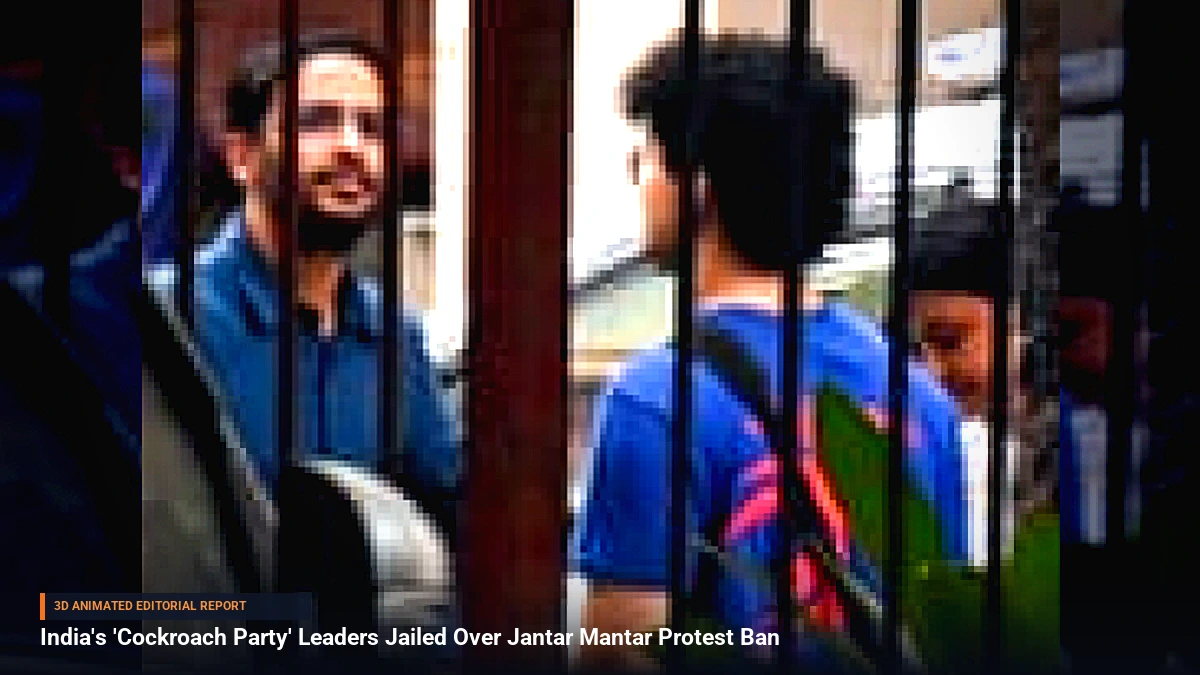
Two central leaders of India's emerging Cockroach Janata Party (CJP) movement, Saurav Das and Ashutosh Ranka, were remanded to five days of judicial custody in Delhi's high-security Tihar prison. The judicial action follows their detention during an unauthorized demonstration at New Delhi’s historic Jantar Mantar venue.
According to law enforcement and court filings, the CJP leaders breached security by jumping police barricades, unfurling the Indian national flag, and raising slogans against state measures. While Das and Ranka faced immediate judicial remand under trespassing and related charges, a third associated individual, Ajinkya Shinde, was handled differently under preventive measures and subsequently released.
Background & Key Context
The flashpoint centers around the CJP's sustained mobilization against the Chief Election Commissioner (CEC), fueled by allegations of irregularities in the ongoing Special Intensive Revision (SIR) electoral exercises. Jantar Mantar, historically recognized as the epicenter of public demonstrations and democratic expression in the national capital, has increasingly faced strict regulatory curbs.
Authorities had previously denotified and closed the landmark site as an official protest venue, citing security and public order concerns. Despite these sweeping restrictions, youth-led political groups have increasingly sought to challenge the closure, framing it as an unconstitutional erosion of the fundamental right to assemble and voice dissent.
Key Takeaways
- Judicial Custody: CJP leaders Saurav Das and Ashutosh Ranka were sent to Tihar prison for five days.
- The Protest Site: The demonstration occurred at Jantar Mantar, which authorities had previously denotified and closed to public protests.
- Political Backing: Senior opposition leader Rahul Gandhi publicly condemned the arrests, offering critical support to the jailed activists.
- Differential Handling: While Das and Ranka faced stringent trespass charges, co-activist Ajinkya Shinde was let off under separate preventive protocols.
- Core Grievance: The CJP movement’s demonstrations are primarily targeted against the Chief Election Commissioner regarding electoral roll irregularities.
Impact, Analysis & Global/National Reactions
The incarceration of the CJP leadership has catalyzed a broader discussion regarding the space allocated for civil liberties and democratic opposition in contemporary India. Critics argue that utilizing trespassing laws and denotifying historic demonstration sites represents a systematic effort to muzzle youth-led political mobilization.
Senior opposition figures were quick to capitalize on the momentum. In his first public show of support, opposition leader Rahul Gandhi slammed the custodial sentences, asserting that "Jantar Mantar belongs to the people of India" and vowing to reclaim public democratic spaces. Meanwhile, student and civil society organizations, including the All India Students' Association (AISA), have staged localized protests, condemning what they characterize as an authoritarian crackdown on fundamental rights.
Law enforcement authorities, however, defended the intervention, pointing to the explicit violation of prohibitory orders, alleged obstruction of police officers on duty, and what they described as social media instigation designed to bypass public order regulations.
What's Next: Looking Ahead
As Das and Ranka serve out their remaining days in Tihar prison, legal defense teams are expected to move formal bail applications before local courts. Concurrently, the CJP movement and broader opposition coalitions are weighing further mobilization strategies to challenge the continued closure of Jantar Mantar.
Observers note that the episode has thrust youth-led political dissent into national prominence, potentially setting the stage for protracted legal and political battles over freedom of assembly ahead of upcoming electoral milestones.





Be the first to comment
Start a useful conversation around this story.