
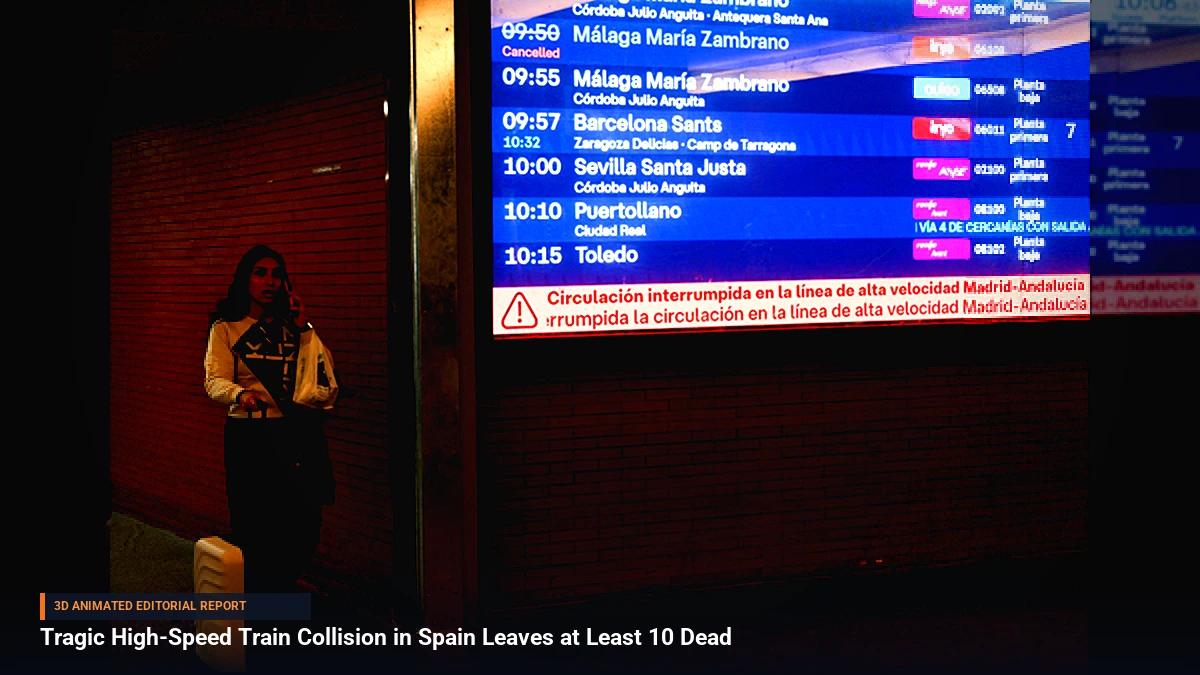
What Happened: The Core Developments
A devastating rail disaster struck Spain when at least 10 people were killed in a high-speed train collision. According to local authorities and emergency responders, the catastrophic incident occurred when a moving high-speed train slammed directly into the rear of another train that had come to a halt on the tracks. The tremendous impact forced multiple cars off the rails, resulting in at least two carriages derailing completely and triggering a massive emergency response from local and national rescue teams.
Emergency services rushed to the scene to triage the injured, cut through mangled metal, and secure the surrounding area. While precise figures regarding hospitalizations and total injury counts remain fluid as rescue operations continue, officials have confirmed that the death toll has reached double digits. First responders have deployed specialized heavy-lifting equipment to stabilize the derailed carriages and search for any passengers who may still be trapped inside the wreckage.
Background & Key Context
Spain boasts one of the most advanced and extensive high-speed rail networks in Europe, moving millions of passengers annually across high-capacity corridors like the AVE system. The country's infrastructure is generally regarded as having rigorous safety standards, making catastrophic rear-end collisions exceptionally rare.
Typically, modern high-speed lines rely on sophisticated signaling systems, automated train protection (ATP), and centralized traffic control to maintain safe distances between moving vehicles and prevent collisions. The fact that a moving train managed to strike a stationary train points toward potential anomalies in signaling, communication failures, or human operational errors that investigators will now scrutinize under a microscope.
Key Takeaways
- Fatal Collision: At least 10 individuals have lost their lives in the tragic crash.
- Mechanism of Impact: A high-speed train struck the rear end of a stationary train on the tracks.
- Derailment: The impact caused at least two carriages to derail, complicating rescue and extraction efforts.
- Emergency Response: Multi-agency rescue operations were immediately deployed to the site to treat the injured and secure the area.
- Ongoing Investigation: Transportation safety boards and judicial authorities have launched formal inquiries into the cause of the disaster.
Impact, Analysis & Global/National Reactions
The disaster has sent shockwaves through Spain’s transportation sector, prompting immediate expressions of grief and solidarity from national leaders. Transport authorities and railway operators are facing intense public scrutiny regarding how a stationary train could be struck from behind on a supposedly secure high-speed network.
Industry analysts note that while mechanical failures are possible, modern rail safety architectures are theoretically engineered with multiple redundancies to override or prevent such overlapping occupancies of track segments. Transport unions and safety advocates have called for absolute transparency as the investigation unfolds, emphasizing the urgent need to restore public trust in the safety of high-speed rail corridors.
What's Next: Looking Ahead
In the coming days, federal transport safety investigators, forensic engineers, and judicial magistrates will focus on downloading data from the black boxes of both trains, analyzing signaling logs, and reviewing communication transcripts between the train operators and the central traffic control room.
Furthermore, government officials are expected to face parliamentary questioning regarding national rail maintenance budgets, signaling system upgrades, and operational protocols. The findings of this investigation are expected to have profound regulatory implications not only for Spain's railway network but also for high-speed rail safety standards across the broader European Union.





Be the first to comment
Start a useful conversation around this story.