
What Happened: The Core Developments
A legal and political firestorm has erupted across New York State following revelations surrounding a 2024 sexual assault inquiry at Cornell University. A survivor, identified publicly in court filings and reports as Jane Doe, alleges that she was raped by seven male students inside a campus fraternity house. Recent leaks of police transcripts and digital evidence—including Snapchat records—have brought intense public scrutiny to the case. According to the released transcripts, the victim explicitly told campus police investigators, "I can say with 100% confidence I was raped."
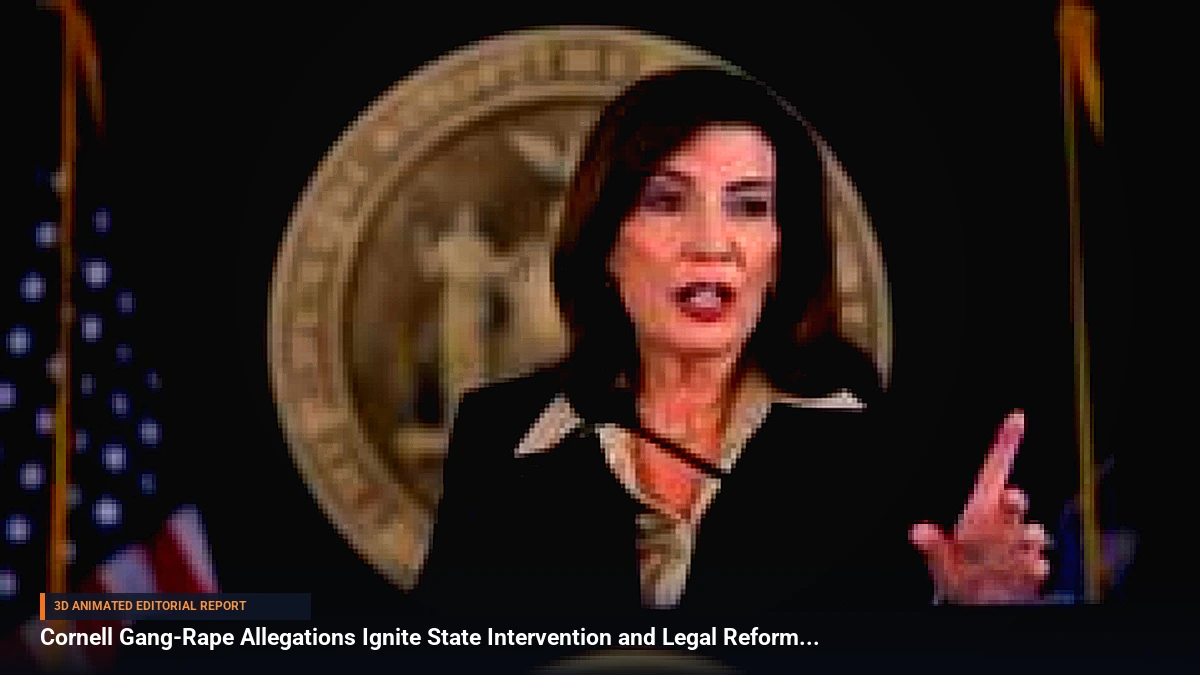
Despite these harrowing assertions, the initial handling of the investigation by local law enforcement and the county prosecutor drew fierce criticism. The systemic stagnation of the probe ultimately prompted direct intervention from New York's state leadership. New York Governor Kathy Hochul announced that the victim had been profoundly failed by the institutions legally mandated to protect her, paving the way for a sweeping state-level takeover of the inquiry.
Background & Key Context
The events trace back to an incident in 2024 at an Ithaca campus fraternity house, which has since become a flashpoint for campus safety discussions nationwide. For months, student frustration boiled beneath the surface, culminating in campus walkouts and rallies where students held signs expressing shame and demanding systemic accountability from university administrators.
Concurrently, the case has highlighted long-standing loopholes and controversial definitions within New York’s penal code regarding sexual assault and intoxication. Under current state statutes, prosecutors face distinct legal hurdles depending on whether a victim's intoxication or incapacitation was achieved voluntarily or involuntarily. This distinction has historically complicated accountability in campus-based alcohol-fueled assaults, leading to renewed calls for legislative reform.
Key Takeaways
- State Takeover: New York Attorney General Letitia James has been appointed as a special prosecutor to take full control of the Cornell sexual assault investigation.
- Severe Institutional Criticism: Governor Kathy Hochul explicitly stated that local police departments and the county prosecutor failed the survivor.
- Crucial Evidence Emerged: Newly surfaced Snapchat records and police transcripts have provided fresh momentum and transparency to the stalled probe.
- Legislative Pressure: The case has reignited a major push in the New York legislature to reform laws concerning how intoxication and incapacitation affect sexual assault cases.
- Student Outrage: Cornell students have staged vocal protests and campus demonstrations, expressing deep anger and demanding institutional transparency.
Impact, Analysis & Global/National Reactions
The developments at Cornell University have transcended a localized campus scandal, morphing into a landmark test of New York's judicial and political commitment to handling institutional sexual violence. By appointing Attorney General Letitia James as a special prosecutor, the state has signaled that local mechanisms are inadequate when dealing with powerful institutions and complex campus dynamics.
"We are going to ensure that all the facts are brought into the light," Governor Hochul stated during a joint press briefing with Attorney General James. Legal analysts note that state-level intervention of this magnitude is exceptionally rare, indicating that the initial investigatory missteps were egregious enough to warrant extraordinary judicial overrides. Civil rights advocates and survivor support networks have praised the state's intervention while simultaneously demanding long-overdue statutory overhauls to address systemic biases within the justice system.
What's Next: Looking Ahead
With Attorney General Letitia James now spearheading the investigation, a thorough review of all previous evidence, digital records, and witness testimonies is underway. The transition of jurisdiction is expected to accelerate potential grand jury proceedings or indictments related to the 2024 fraternity house incident.
Simultaneously, state lawmakers are facing mounting pressure when the legislative session resumes to amend New York's penal code regarding consent and intoxication. Legal reformers are pushing to eliminate loopholes that differentiate between voluntary and involuntary consumption during instances of incapacitation, a change that could fundamentally alter how future sexual assault cases are prosecuted across the state.





Be the first to comment
Start a useful conversation around this story.