
What Happened: The Core Developments
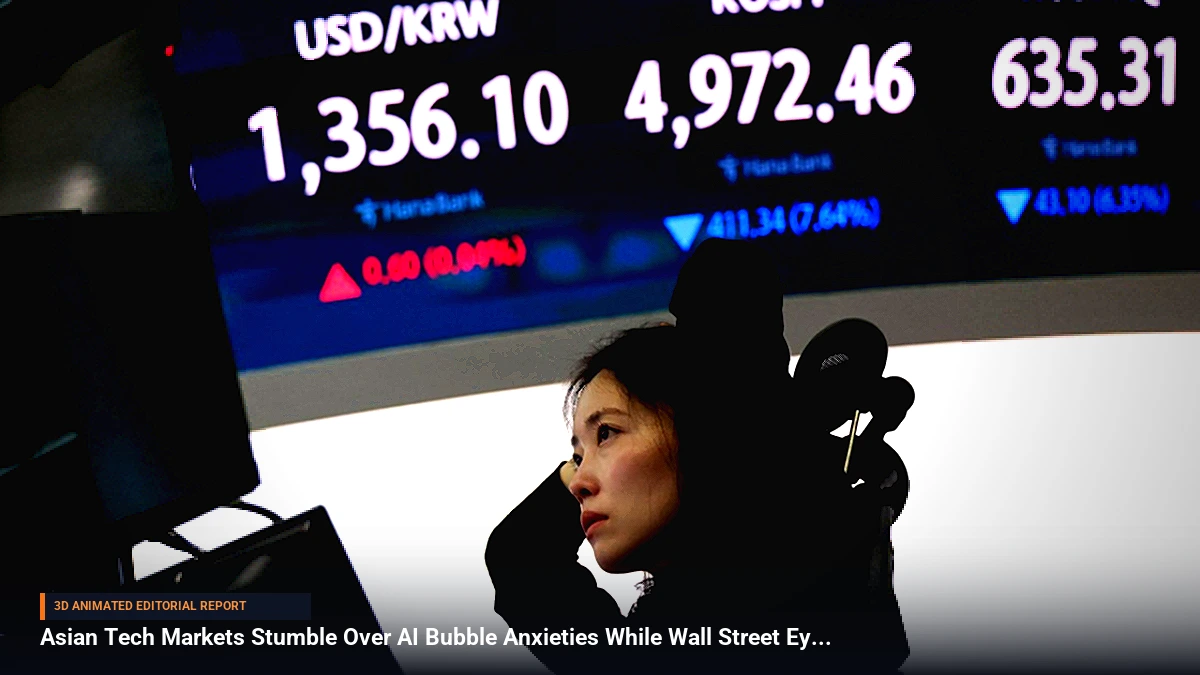
A fresh wave of market turbulence has hit international financial exchanges, centered primarily around intense anxiety regarding the sustainability of the artificial intelligence boom. Asian stock markets, particularly heavy tech-concentrated hubs such as South Korea, Taiwan, and Hong Kong, suffered notable tumbles during a broad technology-led sell-off.
However, the global picture remains deeply divided. While Asian exchanges struggled to contain the rout—exhibiting mixed results where indices like Taiwan's market attempted tentative rebounds while South Korea's KOSPI slid further—Wall Street and U.S. futures pointed in the opposite direction. U.S. stock futures, including major benchmarks for the Dow Jones, S&P 500, and Nasdaq, surged in early trading, setting the stage for a robust relief rally to offset previous domestic tech corrections.
Background & Key Context
The current anxiety stems from months of unprecedented capital expenditure and skyrocketing valuations tied to generative artificial intelligence infrastructure, semiconductor manufacturing, and software integration. For the past several quarters, tech giants and semiconductor powerhouses across Asia have served as the primary engine for global equity gains.
Yet, as valuations have scaled historic peaks, institutional and retail investors alike have begun questioning the timeline for monetizing massive artificial intelligence investments. This skepticism has left regional markets exceptionally vulnerable to sudden shifts in risk sentiment, triggering sharp corrections whenever earnings reports or macro forecasts fail to justify astronomical growth expectations.
Key Takeaways
- Geographical Divergence: Asian tech hubs faced steep selling pressure over AI bubble concerns, while U.S. futures prepared for a strong relief rebound.
- Regional Disparities: Efforts by Asian policymakers and exchanges to stem the stock rout yielded mixed outcomes, with selective recoveries seen in Taiwan contrasted by continuous slides in South Korea's KOSPI.
- Sector Concentration: The sell-off heavily targeted semiconductor suppliers and high-flying tech hardware manufacturers linked directly to the AI supply chain.
- Investor Sentiment: Market participants are shifting from aggressive growth chasing to a more cautious, valuation-conscious approach.
Impact, Analysis & Global/National Reactions
Financial analysts note that the stark contrast between struggling Asian tech exchanges and recovering U.S. futures underscores a complex global sentiment. While U.S. markets appear eager to buy the dip, Asian investors are wrestling more directly with the manufacturing realities and capital expenditure risks inherent in hardware-heavy supply chains.
Market strategists have emphasized that the high correlation between major tech indexes means any hint of overvaluation in Silicon Valley quickly ripples through Asian fabrication plants and assembly hubs. Consequently, regional central banks and financial regulators are keeping a close watch on liquidity and market stability to prevent systemic contagion from spreading beyond the technology sector into broader regional economies.
What's Next: Looking Ahead
As markets digest the immediate aftermath of the tech sell-off, all eyes will be on upcoming corporate earnings reports from major US and international tech bellwethers. Investors will scrutinize capital expenditure guidance, enterprise adoption rates, and tangible revenue returns from artificial intelligence deployments.
For Asian markets, stabilization will largely depend on whether upcoming macroeconomic data can restore confidence in regional manufacturing demand. If tech valuations face further downward revisions, volatility is expected to remain a defining characteristic of global equities through the remainder of the quarter.






Be the first to comment
Start a useful conversation around this story.