
What Happened: The Core Developments
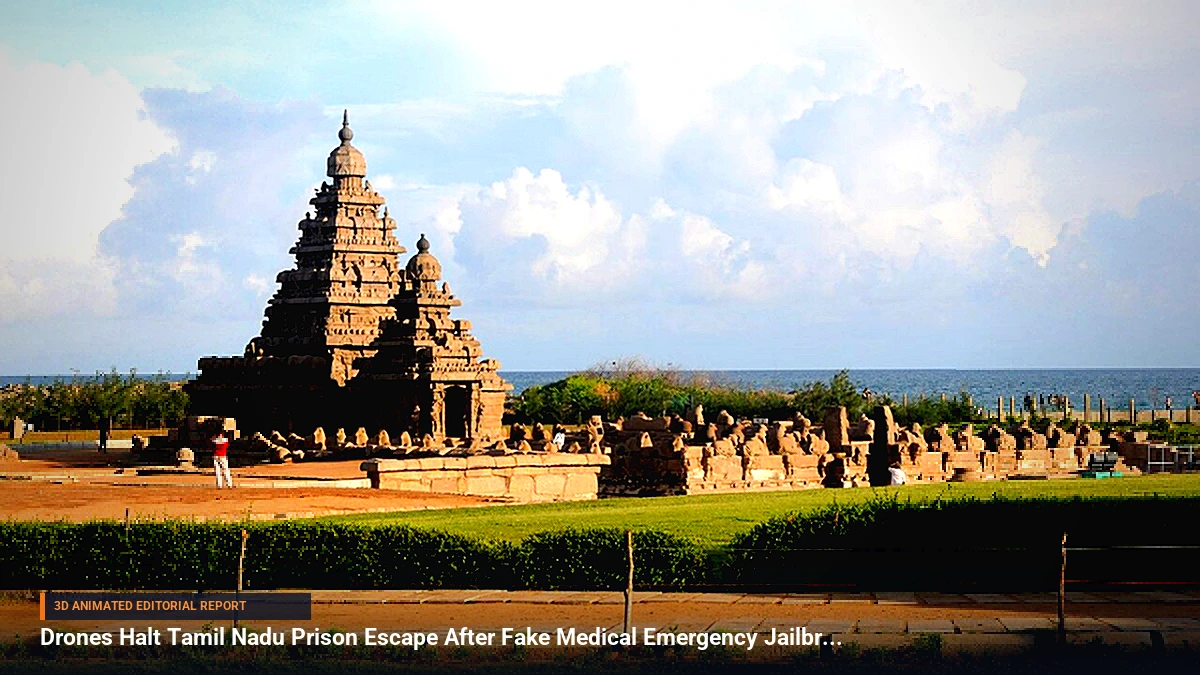
A correctional facility in Tamil Nadu recently became the site of a meticulously planned yet ultimately short-lived jailbreak involving seventeen prisoners. The inmates executed their escape by staging a fake medical emergency, simulating a sudden seizure that prompted a security response. When a corrections officer moved in to assist, the inmates overpowered and attacked the guard, breaching security protocols and fleeing the facility en masse.
The group sought refuge in a nearby dense forest, attempting to use the thick canopy and rugged terrain to evade law enforcement. However, the authorities deployed advanced aerial surveillance, utilizing modern drones to scan the dense foliage and pinpoint the fugitives' locations. Within hours, the technological advantage neutralized the low-tech evasion tactics, leading to a massive manhunt response. While initial reports indicated that four individuals were swiftly rounded up, subsequent updates confirmed that the vast majority—thirteen escapees—have since been successfully brought back into custody.
Background & Key Context
Prison breaks leveraging psychological ruses and human empathy are among the oldest tricks in penal history. By exploiting standard operating procedures designed to render medical assistance during emergencies, the inmates managed to create a momentary vulnerability in the facility's defenses. Yet, while the inception of the escape relied on classic, low-tech manipulation, the conclusion of the manhunt highlights a fundamental shift in modern law enforcement and corrections management: the integration of unmanned aerial vehicles (UAVs) in tactical operations.
Dense forests have historically provided an exceptional sanctuary for escaped convicts, often requiring days or weeks of ground-based grid searches by large police contingents. The deployment of drones equipped with thermal and high-resolution optical sensors dramatically compresses this timeline, turning hours of hiding into an untenable proposition for fugitives. This incident underscores how rapidly correctional security and regional police forces are adopting airborne assets to secure perimeter breaches.
Key Takeaways
- Audacious Plot: Seventeen prisoners executed a breakout by faking a medical emergency and assaulting an on-duty guard.
- Forest Hideout: The escapees fled into a dense forest canopy, attempting to leverage natural terrain to avoid detection.
- Aerial Tracking: Modern drone technology played a decisive role in locating the hidden fugitives from above.
- Recapture Totals: While initial estimates reported four recaptures, updated figures confirm that 13 prisoners have been returned to custody.
- Political Fallout: Regional political figures have sharply criticized the facility's management, demanding strict disciplinary measures against negligent staff.
Impact, Analysis & Global/National Reactions
The swift termination of the jailbreak has redirected public and official discourse away from the sensationalism of the escape itself and squarely onto institutional accountability. Prominent political leaders, including figures such as Anbumani, have publicly condemned the security lapse, calling for immediate punitive action against prison officials whose negligence allowed the plot to succeed.
Security analysts note that while tactical technology like drones successfully mitigated the immediate public safety threat, the root cause points to structural vulnerabilities within regional correctional facilities. "When routine medical protocols can be weaponized to compromise perimeter security, the failure is systemic rather than isolated," remarked a security policy observer. Stakeholders across the correctional ecosystem are now re-evaluating whether current staffing levels and standard operating procedures for medical responses require an urgent overhaul to prevent copycat incidents.
What's Next: Looking Ahead
In the wake of the incident, Tamil Nadu correctional authorities are expected to release a comprehensive internal audit detailing the precise breakdown of security measures during the shift. Administrative inquiries will focus on the handling of the alleged medical emergency and the adequacy of guard-to-inmate ratios.
Furthermore, the remaining unrecovered escapees face intense ongoing search operations as law enforcement closes the net. For correctional facilities nationwide, the event serves as a stark reminder that while technological tools like drones are indispensable for recovery, hardening internal protocols against deception remains the first and best line of defense.




Be the first to comment
Start a useful conversation around this story.