
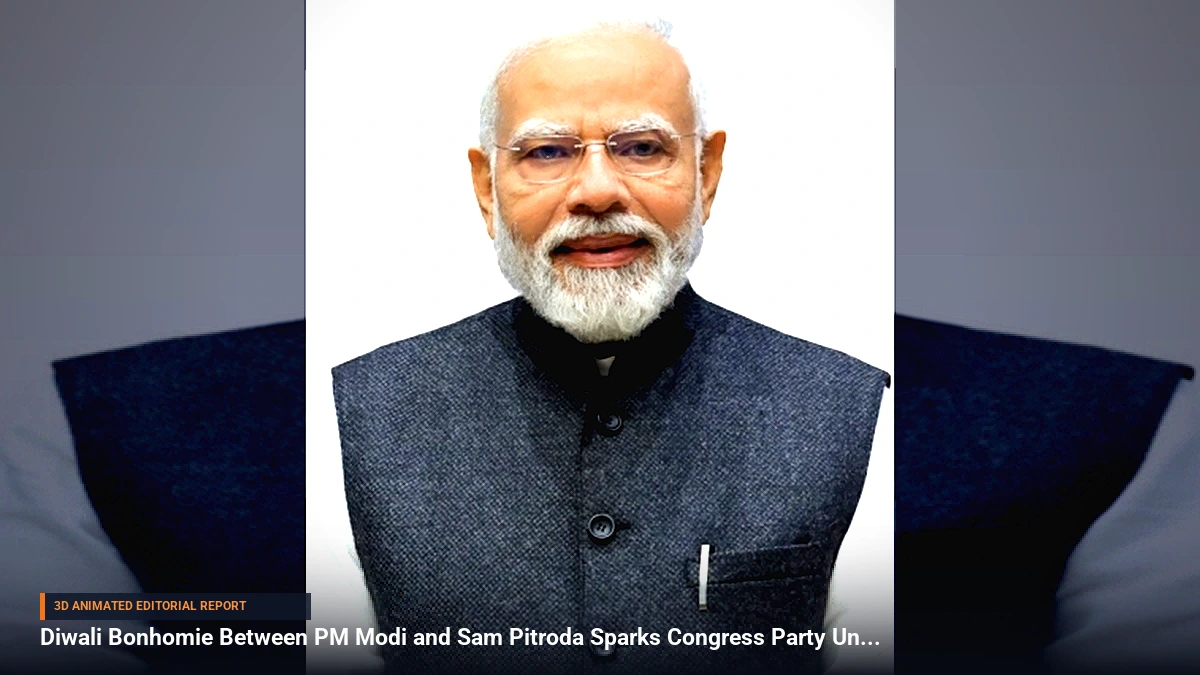
What Happened: The Core Developments
Recent festive celebrations across India yielded an unexpected political subplot when Prime Minister Narendra Modi and senior Indian National Congress leader Sam Pitroda engaged in a public exchange of warm Diwali greetings. The interaction gained widespread traction after Sam Pitroda publicly referred to the Prime Minister as his “very loving Gujarati friend” and asserted that he harbored no personal animosity toward him at an individual level.
In response to these remarks, Prime Minister Modi extended his own courteous Diwali wishes to Pitroda. However, this display of mutual goodwill quickly transcended the spirit of the festive season, triggering sharp internal debates, political commentary, and visible unease among leaders and strategists within the Congress party.
Background & Key Context
The unexpected bonhomie comes at a delicate political juncture for the opposition. The public exchange coincided closely with political discourse surrounding a memoir released by senior Congress leader Sonia Gandhi, which took direct aim at Prime Minister Modi's governance and policies.
While personal civility between political opponents is historically not unprecedented in Indian politics, the timing of Pitroda’s praise starkly contrasted with the high-stakes narrative the opposition party has been attempting to build. For a party working meticulously to present a united and aggressive front against the ruling government, public compliments from a senior insider toward the principal political adversary proved to be a jarring dissonance.
Key Takeaways
- Unexpected Warmth: Prime Minister Narendra Modi and Congress leader Sam Pitroda exchanged cordial Diwali wishes publicly.
- Personal Remarks: Pitroda described the Prime Minister as a "very loving Gujarati friend," emphasizing a lack of individual-level grievances.
- Timing Friction: The friendly exchange occurred concurrently with aggressive political messaging from the Congress leadership, including statements linked to Sonia Gandhi's memoir.
- Internal Disquiet: The public bonhomie generated notable discomfort and debate within Congress circles.
- Political Exploitation: The ruling Bharatiya Janata Party (BJP) welcomed the remarks, leveraging the goodwill to highlight fractures in opposition solidarity.
Impact, Analysis & Global/National Reactions
The incident has laid bare the complex friction points between personal courtesies and strict partisan discipline in contemporary Indian politics. Political analysts note that while individuals across party lines often maintain cordial private relationships, public affirmations of warmth toward a primary political rival can severely disrupt carefully orchestrated party messaging.
Following the uproar, Pitroda himself questioned the rationale behind the controversy, asking why simple festive exchanges should warrant political speculation. Meanwhile, representatives from the ruling Bharatiya Janata Party (BJP) welcomed the remarks as a reflection of political maturity, contrasting it with what they described as the opposition's persistent negativity. Conversely, several internal Congress factions expressed frustration, arguing that such statements dilute the party's core political messaging and undermine collective opposition efforts.
What's Next: Looking Ahead
As the political dust settles, party leadership is expected to re-evaluate communication guidelines for senior members to prevent mixed messaging during crucial electoral and legislative phases. The episode serves as a reminder of how quickly personal narratives can intersect with—and occasionally disrupt—macro-level political strategies in India's highly polarized democratic landscape.



Be the first to comment
Start a useful conversation around this story.