
What Happened: The Core Developments
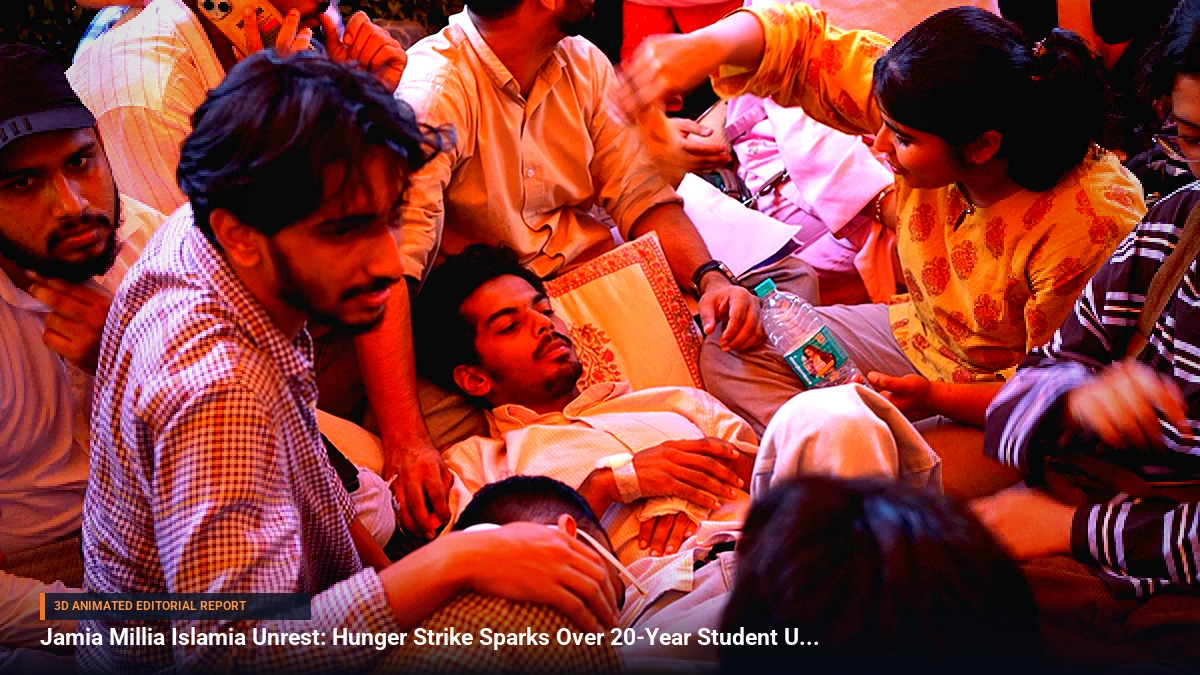
Tension has escalated significantly at New Delhi's prominent Jamia Millia Islamia (JMI) university, where student bodies have staged intense demonstrations and a hunger strike. The core grievance driving the student movement is the urgent demand for the restoration of the students' union, an institutional body that has been absent from campus life for an extended period.
Rather than engaging in formal dialogue with the protesting students, the university administration responded with sweeping disciplinary measures. JMI officially ordered the shutdown of the physical campus until mid-January, forcing all academic classes and examinations to transition entirely to online formats. Additionally, the administration targeted specific activists, issuing a formal show-cause notice to a prominent protesting hostel resident in an effort to curb the momentum of the movement.
Background & Key Context
The roots of the current unrest stretch far back into the institutional history of the university. Crucially, no students' union elections have been held at Jamia Millia Islamia for 20 years, creating a prolonged vacuum of democratic student governance. Critics and student advocates argue that this intentional suppression of representative bodies strips young scholars of their collective voice and institutional accountability.
This administrative reluctance to permit democratic bodies extends beyond the student body. Data indicates that teacher association polls at Jamia have likewise been frozen for six years, persisting despite explicit legal directives, such as a Delhi High Court order that formally quashed a previous ban on faculty elections. The ongoing standoff highlights a broader structural pattern of governance resistance across several central institutions of higher education in India.
Key Takeaways
- Two-Decade Freeze: Jamia Millia Islamia has not conducted student union elections in 20 years, serving as the central catalyst for current student grievances.
- Direct Action: Students have organized active demonstrations alongside a high-stakes hunger strike to pressure university leadership.
- Administrative Clampdown: In lieu of negotiations, JMI shut down its physical campus until mid-January and moved all academic schedules online.
- Targeted Penalties: Authorities have issued formal show-cause notices to active participants, particularly targeting hostel residents involved in the protests.
- Broader Governance Crisis: Faculty association elections have similarly been stalled for six years, ignoring legal judgments from the Delhi High Court.
Impact, Analysis & Global/National Reactions
The suppression of democratic processes at JMI has triggered widespread debate regarding academic freedom, free speech, and civil liberties within Indian higher education. Educational analysts point out that student unions have historically served as crucial training grounds for leadership, social justice, and institutional transparency. By completely dismantling these structures for two decades, critics argue that university administrations risk fostering deeper alienation and systemic distrust among the student populace.
Furthermore, the sudden closure of the campus and pivot to online learning has drawn criticism from student welfare advocates, who view the move as an administrative tactic designed to disperse collective organizing and evade accountability. The unfolding situation at Jamia continues to draw solidarity comparisons with other prominent Indian central universities, such as Jawaharlal Nehru University (JNU) and Aligarh Muslim University (AMU), where student political engagement remains a central pillar of campus identity.
What's Next: Looking Ahead
As the campus remains closed through mid-January under the online learning mandate, observers are closely monitoring whether the administration's hardline stance will successfully suppress the protests or merely drive student organizing further underground. Legal experts are also watching to see if the ongoing disregard for judicial rulings—such as the stalled teacher association elections—will prompt fresh legal interventions in the Delhi High Court. Ultimately, the resolution of the JMI crisis will serve as an important litmus test for the future of student rights and democratic governance within India's central universities.
Be the first to comment
Start a useful conversation around this story.