
What Happened: The Core Developments
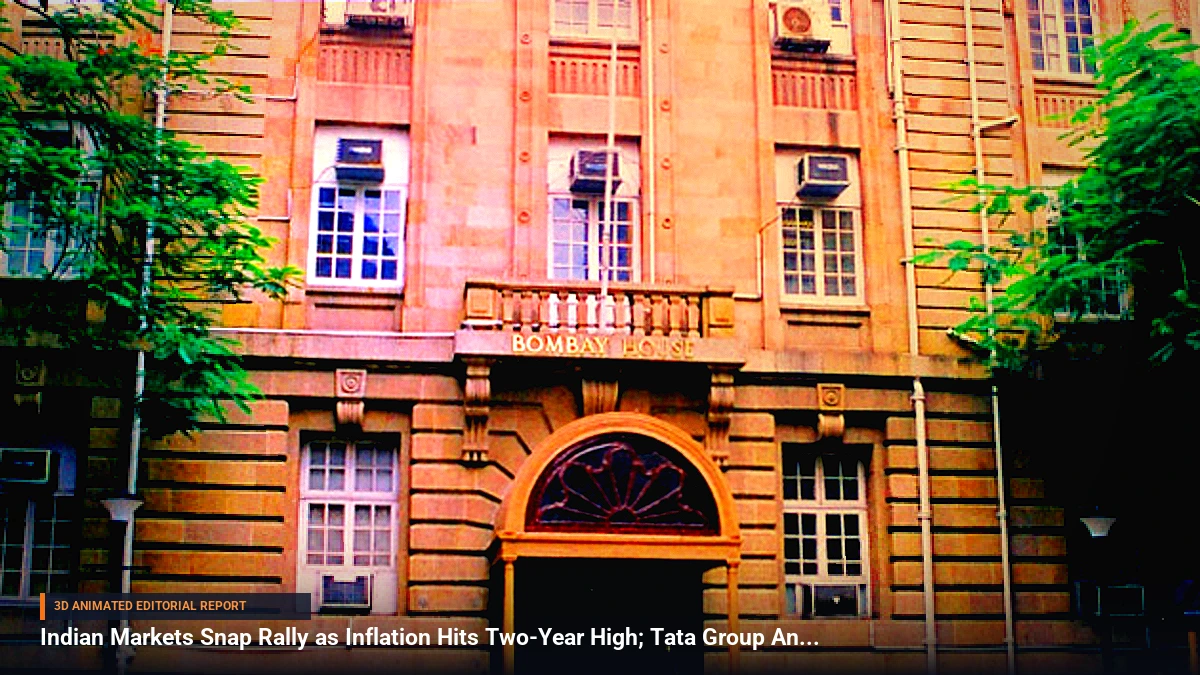
Indian equity benchmarks faced a notable pullback, snapping a three-day winning streak as macroeconomic pressures took center stage. The benchmark Sensex settled 319 points lower, while the broader Nifty index closed at 25,144, pressured by declines across key sectoral indices including Nifty Bank, Auto, and Realty, which each slid roughly one percent.
The primary catalyst for the cautious market sentiment was the release of macroeconomic data revealing that India's retail inflation soared to a two-year high of 6.1 percent (reported precisely at 6.09 percent) in October 2026. This uptick breached the Reserve Bank of India’s (RBI) upper tolerance threshold, immediately triggering market anxieties regarding potential monetary policy tightening and upcoming rate hikes.
Simultaneously, corporate developments captured investor attention as the Tata Group announced high-profile leadership transitions. Tata International appointed T V Narendran as its new chairman, while Noel Tata stepped down from his role, marking a notable generational and structural pivot within the conglomerate's management architecture.
Background & Key Context
For months, Indian indices had enjoyed a robust bullish phase buoyed by steady domestic institutional inflows and resilient corporate earnings. However, underlying vulnerabilities regarding food and commodity price pressures had been quietly mounting. The October retail inflation print shattered a prolonged period of relative price stability, forcing analysts and institutional economists to re-evaluate their monetary policy outlooks.
The RBI has historically maintained a strict stance on keeping inflation anchored within its target band of 2 to 6 percent. Crossing this ceiling for the first time in two years directly challenges the central bank's previous trajectory of rate pauses, leading major institutions like ICICI Bank to project a potential 25 basis point rate hike as early as the upcoming December policy meeting.
In tandem with macroeconomic headwinds, the Tata Group's executive shuffle represents a continuation of strategic restructuring across its diverse portfolio of companies. Leadership changes at entities like Tata International and Tata Investment reflect a deliberate approach to succession planning and governance enhancement.
Key Takeaways
- Inflation Spike: India's retail inflation surged to 6.09 percent in October, breaching the RBI's 6 percent upper tolerance band for the first time in two years.
- Market Correction: The BSE Sensex fell 319 points, ending a three-day winning streak, with the Nifty settling at 25,144.
- Sectoral Drag: Interest-sensitive sectors including banking, automotive, and real estate faced the brunt of the sell-off, declining by about one percent.
- Rate Hike Apprehensions: Markets are now pricing in a higher probability of a Reserve Bank of India rate hike during the upcoming monetary policy review.
- Corporate Leadership Shift: T V Narendran was appointed as the new chairman of Tata International following Noel Tata's departure.
Impact, Analysis & Global/National Reactions
Market analysts suggest that the cooling of domestic indices is a healthy, albeit abrupt, realization of macroeconomic risks that investors had temporarily sidelined. The persistent climb in food prices has complicated the central bank's task, shifting the narrative from growth-supportive liquidity to defensive inflation management.
"When inflation breaches the upper limit, fixed-income yields and equity valuations undergo an immediate recalibration," noted market strategists following the release of the consumer price index data. Institutional forecasts now point toward tighter monetary conditions, which could increase borrowing costs for corporations and retail consumers alike.
On the corporate front, the transition at Tata International underscores the conglomerate's ongoing evolution in governance. Industry watchers view the appointment of seasoned leaders like T V Narendran as a stabilizing move designed to steer traditional industrial arms through a volatile global commodity and trade environment.
What's Next: Looking Ahead
Investors and market participants will closely monitor incoming high-frequency economic indicators to gauge whether the October inflation spike is an isolated weather-induced anomaly or a persistent structural trend.
All eyes will be fixed on the upcoming Reserve Bank of India monetary policy committee meeting. Commentary from central bank officials regarding the path of interest rates will dictate market direction through the remainder of the quarter. Concurrently, corporate updates from the Tata Group will be scrutinized to understand the broader operational strategies of the newly appointed leadership teams.



Be the first to comment
Start a useful conversation around this story.