
What Happened: The Core Developments
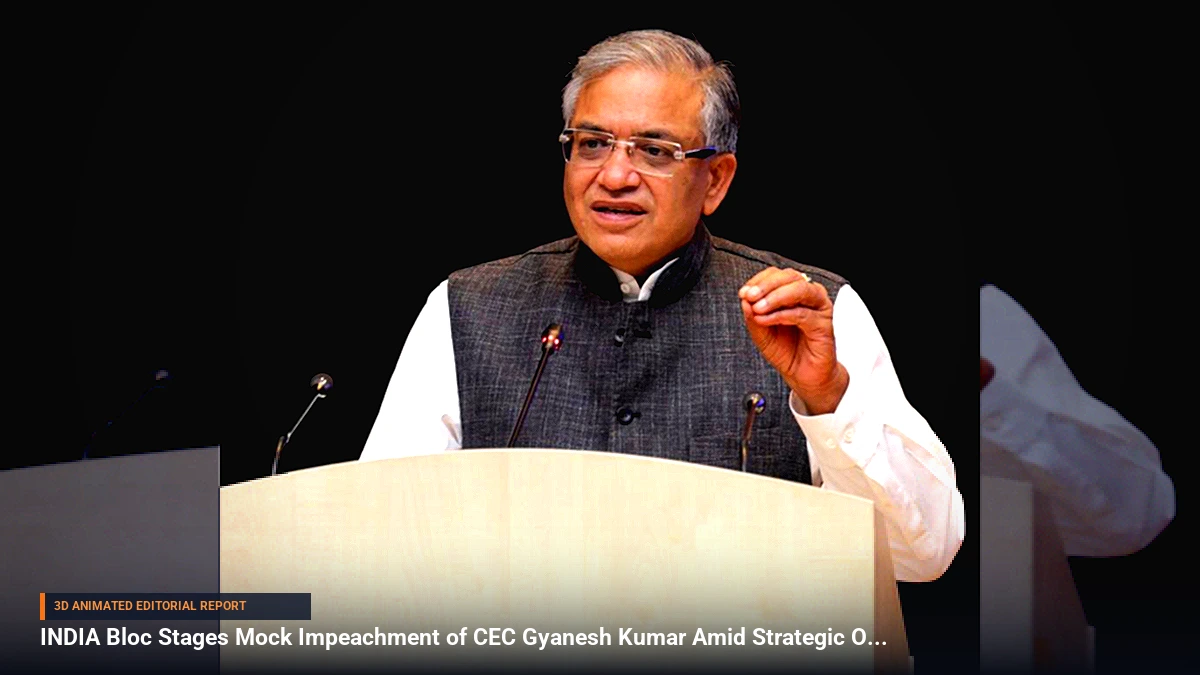
Indian national politics witnessed high-stakes theatrical confrontation as the opposition INDIA bloc convened a major public demonstration, featuring a symbolic "mock parliament" and a public impeachment proceeding directed at Chief Election Commissioner (CEC) Gyanesh Kumar. Leaders from various constituent parties gathered to air grievances over electoral oversight, culminating in formal charges laid out against the top election official during the high-profile assembly.
Simultaneously, the political landscape demonstrated clear fracture lines within the broader opposition umbrella. Notable regional actors opted to maintain distance from the primary mobilization. Furthermore, the ruling Bharatiya Janata Party (BJP) executed a calculated counter-strategy, organizing targeted protest marches in West Delhi to redirect public discourse toward historical accountability.
Background & Key Context
Friction between opposition parties and independent democratic institutions has intensified over recent electoral cycles. The INDIA bloc has repeatedly raised concerns regarding the transparency, neutrality, and systemic conduct of statutory authorities. By executing a mock impeachment featuring six distinct charges against CEC Gyanesh Kumar, opposition strategists sought to galvanize public sentiment ahead of upcoming electoral battles.
However, the coalition faces ongoing challenges regarding internal unity. Strategic recalibrations by key regional players underscore the delicate balancing act required to maintain a cohesive national opposition against a dominant incumbent force.
Key Takeaways
- Symbolic Impeachment: The INDIA bloc conducted a mock parliamentary proceeding to formally level six charges against CEC Gyanesh Kumar.
- Demand for Removal: Prominent opposition voices, including Trinamool Congress (TMC) parliamentarians like Sagarika Ghose, openly demanded the immediate removal of the CEC.
- Opposition Divergence: Key figures declared a strictly neutral stance and skipped the central rally following crucial bilateral political consultations, highlighting cracks in alliance uniformity.
- BJP Counter-Mobilization: The ruling party staged dedicated marches in West Delhi, commemorating victims of the 1984 anti-Sikh riots to counter the opposition narrative.
Impact, Analysis & Global/National Reactions
The simultaneous unfolding of the opposition's anti-CEC campaign and the BJP's counter-marches illustrates a deepening ideological polarization in national politics. Analysts note that while symbolic actions such as mock parliaments successfully capture media headlines and energize core voter bases, they also risk institutional erosion by directly targeting constitutional offices.
Institutional stakeholders have largely emphasized the sanctity and independence of electoral bodies, warning that intense partisan pressure on administrative heads undermines public trust in democratic frameworks. Meanwhile, regional figures walking a tightrope between coalition alignment and regional pragmatism continue to test the longevity of unified opposition fronts.
What's Next: Looking Ahead
As political formations gear up for future electoral contests, both camps are expected to double down on their respective narratives. The opposition plans to sustain pressure on electoral administration protocols, while the ruling coalition will likely leverage historical memory and governance records to challenge the credibility of opposition-led protests.
Be the first to comment
Start a useful conversation around this story.