
What Happened: The Core Developments
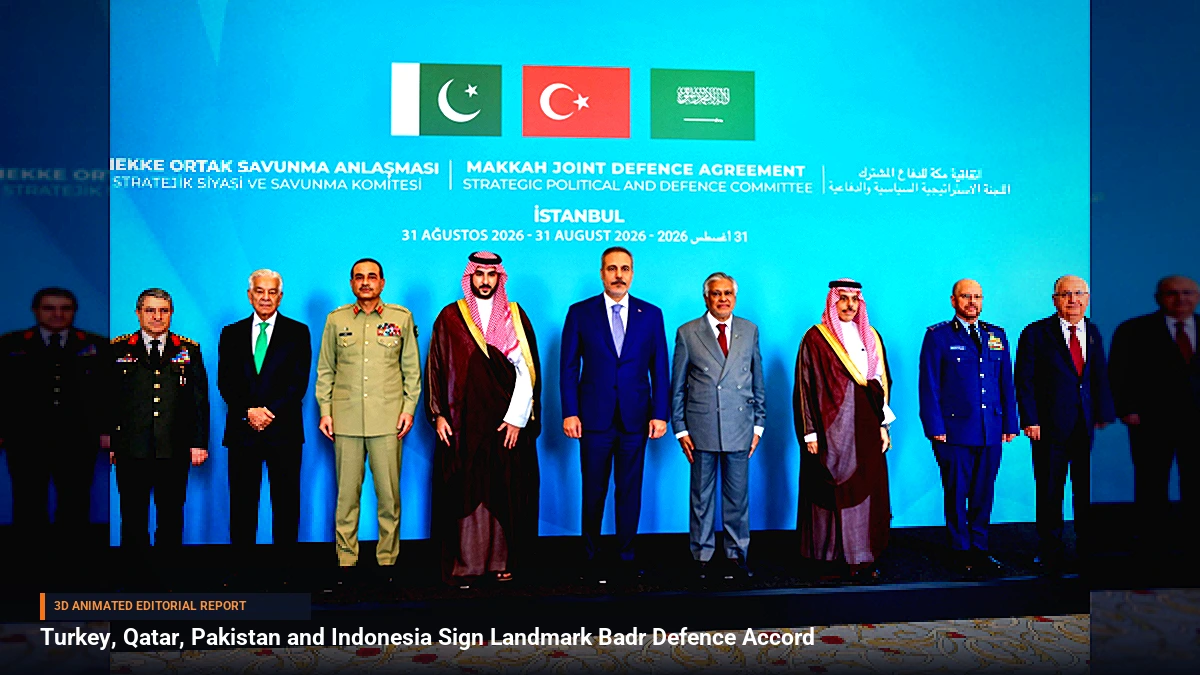
In a landmark geopolitical development, representatives from Turkey, Qatar, Pakistan, and Indonesia have officially signed a sweeping defence cooperation pact known as the Badr accord. Announced by Ankara and corroborated by regional reports, this new framework solidifies military ties among four major non-Arab and Middle Eastern or Asian nations.
Simultaneously, Turkish authorities have advanced efforts to ratify a separate trilateral security agreement known as the Mecca joint defence agreement, which binds Turkey, Saudi Arabia, and Pakistan in close military alignment. Together, these multilateral and trilateral initiatives represent a profound reshaping of defence diplomacy, establishing overlapping security architectures that operate outside traditional Western-led alliances.
Background & Key Context
The formulation of these pacts does not occur in a vacuum. For years, individual bilateral partnerships—such as defense manufacturing ties between Turkey and Pakistan, or strategic energy and security dialogues involving Qatar—have laid the groundwork for deeper institutional integration.
Geopolitical analysts emphasize that the rapid acceleration of these military ties is a direct response to rising global conflicts, persistent regional instability, and a growing perception that traditional security guarantees from legacy Western powers are becoming increasingly unpredictable. By forging minilateral arrangements, these nations are pooling their industrial capacities, geographic advantages, and military expertise to safeguard their respective spheres of influence.
Key Takeaways
- The Badr Accord: Turkey, Qatar, Pakistan, and Indonesia have formally signed a wide-ranging defence cooperation pact.
- The Mecca Agreement: Turkey is simultaneously moving to ratify a separate trilateral defence framework linking it with Saudi Arabia and Pakistan.
- Minilateralism on the Rise: These pacts signal a shift away from traditional, monolithic alliance structures toward flexible, interest-driven minilateral security networks.
- Strategic Geography: The agreements bridge the Middle East, South Asia, and Southeast Asia, creating a vast corridor of cooperative defense capabilities.
- Driving Forces: Experts note that escalating global conflicts and geopolitical uncertainty have catalyzed these swift diplomatic and military alignments.
Impact, Analysis & Global/National Reactions
Strategic observers view the signing of the Badr accord and the progression of the Mecca agreement as a defining moment for modern international relations. As middle powers seek greater strategic autonomy, frameworks like these allow nations with robust industrial bases, such as Turkey and Pakistan, to partner directly with capital-rich Gulf states like Qatar and rising economic powerhouses like Indonesia.
International defense analysts point out that while these pacts emphasize cooperation, capacity building, and joint readiness, they also inevitably alter the strategic calculus for neighboring states and traditional global superpowers. By diversifying their security partnerships, signatories are insulating themselves against shifting foreign policies in Washington, Brussels, and other traditional capitals.
What's Next: Looking Ahead
As the ink dries on the Badr memorandum of understanding, attention now turns to the practical implementation phase. Stakeholders will be watching closely for announcements regarding joint military exercises, defense technology transfers, and industrial manufacturing collaborations.
Furthermore, the formal ratification process of the Mecca agreement in Ankara will serve as a critical barometer for how quickly these diplomatic frameworks transition into operational realities. Observers will monitor whether additional nations choose to dock into these emerging security networks, potentially expanding the Badr framework into an even broader coalition.




Be the first to comment
Start a useful conversation around this story.